The skeleton Mary Anning dug out was about 5 m long. Beside a person 1.75 m tall; ticks every metre.Body shape drawn for this site
- When
- Early Jurassic at Lyme Regis
- Where
- Lyme Regis, Dorset, and elsewhere
- Size
- The skeleton Mary Anning dug out was about 5 m long
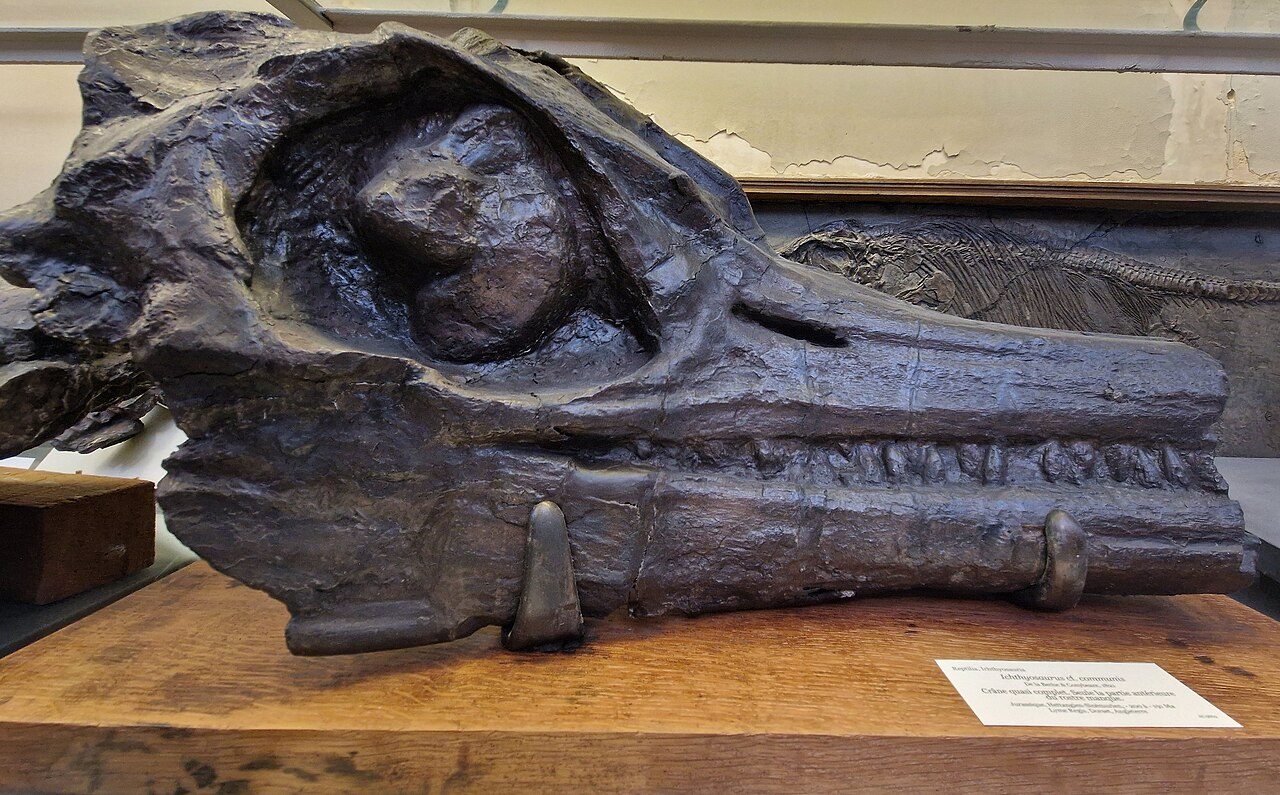
In 1811 Joseph Anning found a strange skull at Lyme Regis. About a year later his sister Mary, then 13, dug out the rest: a five-metre skeleton. By 1820 it was recognised as an extinct sea reptile and named Ichthyosaurus, “fish lizard”, though it was neither fish nor lizard.
It was not the first ichthyosaur found, but it was the first to be studied and described scientifically. One species, Ichthyosaurus anningae, now carries her name.
Found in Britain. See where Britain was at the time in Britain’s journey.
Read more in Fossils.
Also in life in the sea
- Trilobites Armoured sea arthropods that lasted for more than 250 million years
- Graptolites Floating colonies that look like pencil marks on rock
- Sea scorpions Armoured hunters, some longer than a person
- Ammonites Coiled-shell relatives of the nautilus
- Megalodon The largest shark that ever lived
Sources
- Natural History Museum, Mary Anning: the unsung hero of fossil discovery