Didymograptus, a “tuning fork” graptolite from south Wales, was about 2 cm long. Beside a person 1.75 m tall; ticks every metre.Body shape drawn for this site
- When
- About 520 to 350 million years ago; floating from the start of the Ordovician
- Where
- Seas worldwide; in Britain, in Scotland, Wales and north-west England
- Size
- Didymograptus, a “tuning fork” graptolite from south Wales, was about 2 cm long
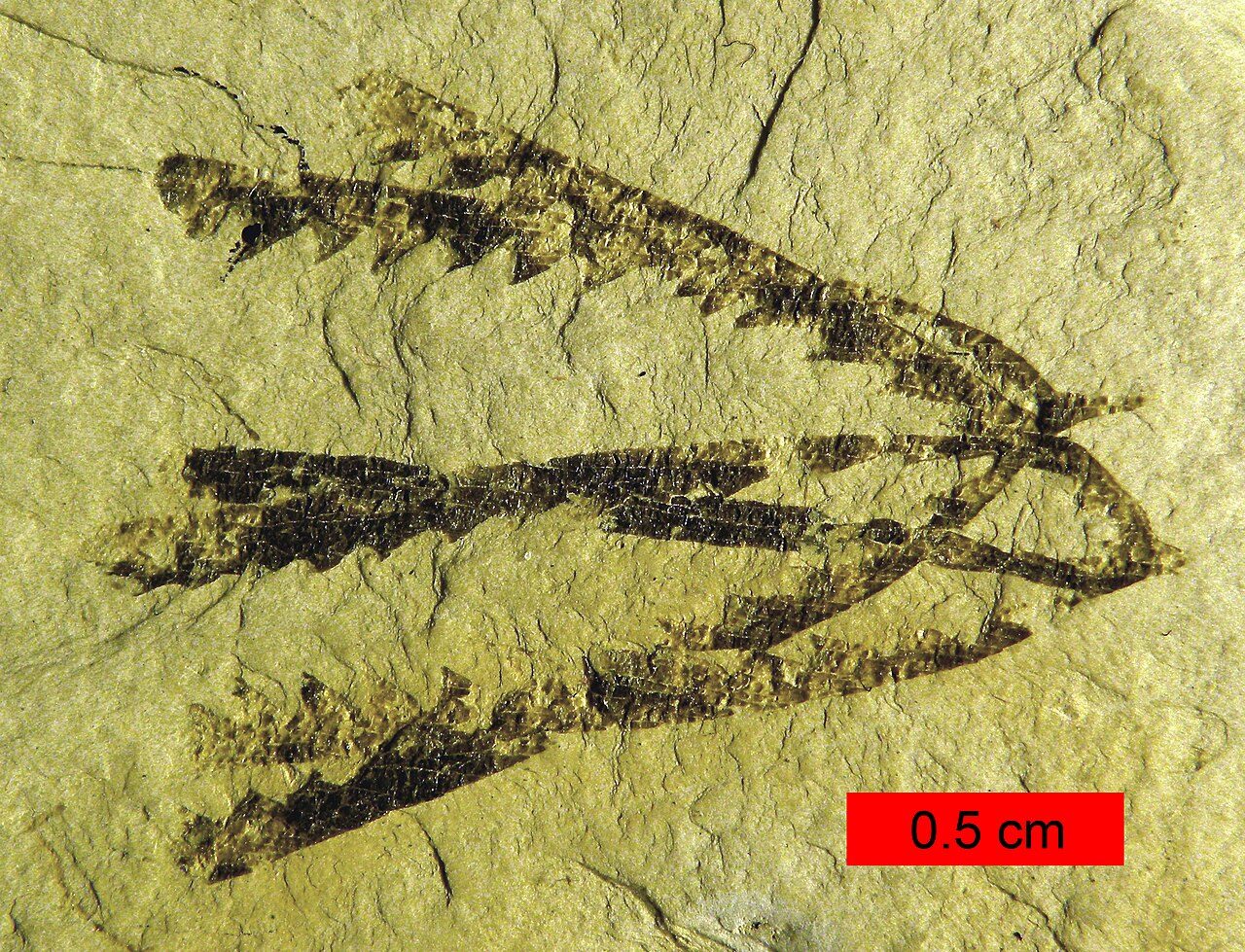
Fossil graptolites are thin, often shiny marks on rock that look as if someone drew them in pencil. Their name means “writing in the rocks”. Each one is the remains of a colony: a branching system of tubes, made of collagen like our fingernails, with one small animal living in each tube. Some colonies held up to 5,000 of them.
The first graptolites lived fixed to the sea bed. At the start of the Ordovician they began to float, and became some of the first animals to live in the open sea, feeding on single-celled life near the surface. New species evolved so fast that geologists use them to date rocks, in slices of time as short as a few hundred thousand years.
They died out long ago, but small sea animals called pterobranchs, alive today, seem to be their close relatives.
Found in Britain. See where Britain was at the time in Britain’s journey.
Also in life in the sea
- Trilobites Armoured sea arthropods that lasted for more than 250 million years
- Sea scorpions Armoured hunters, some longer than a person
- Ichthyosaurus A dolphin-shaped sea reptile
- Ammonites Coiled-shell relatives of the nautilus
- Megalodon The largest shark that ever lived
Sources
- British Geological Survey, Graptolites