Learn · Life · 8 minute read
The first animals
A schoolboy’s find in Leicestershire, a predator named after Attenborough, and the moment life opened its eyes.
Life on Earth is old: there are fossil reefs built by microbes 3,430 million years ago. Animals came very much later. After the Snowball Earth ice ages, in the Ediacaran period between 635 and 538.8 million years ago, the first large living things appear in the rocks.
A schoolboy’s find in Leicestershire
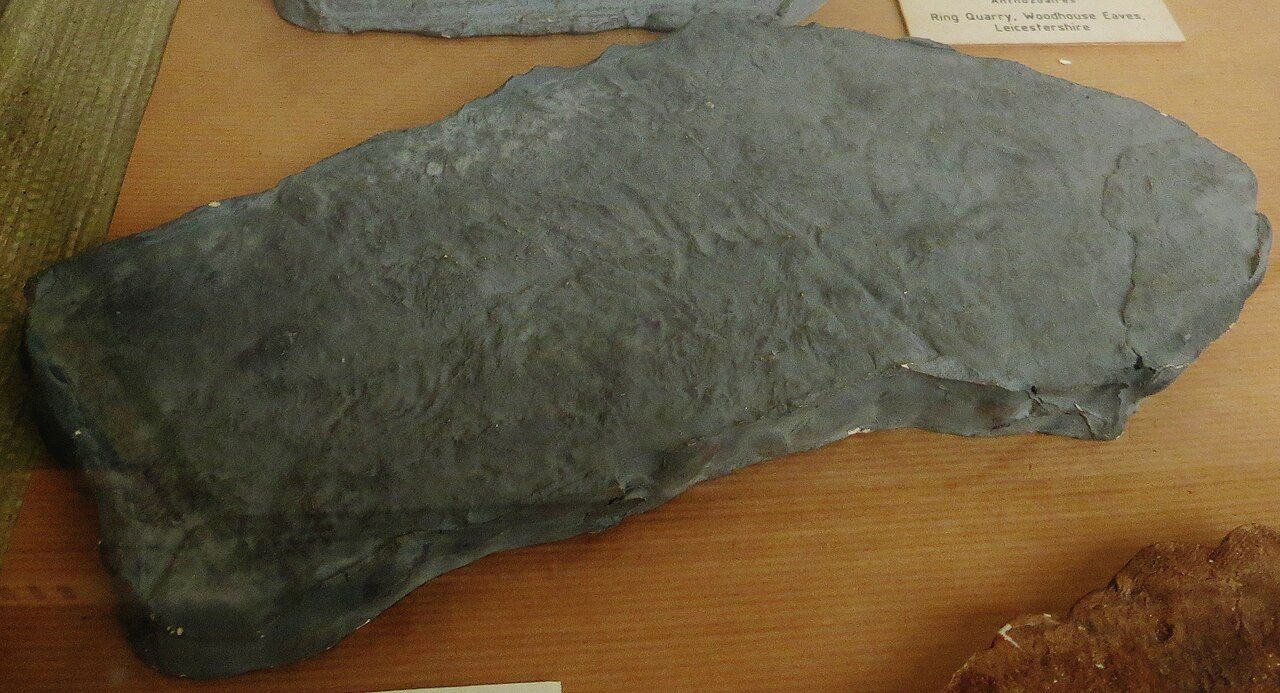
Some of the most important Ediacaran fossils are in England. In 1957, a fern-like impression in a rock in Charnwood Forest, near Leicester, turned out to be one of the oldest fossilised animals known. It was named Charnia masoni after Roger Mason, the Leicester schoolboy who brought it to light. Until then, rocks this old were thought to date from before life began.
Charnwood still surprises. In 2022 scientists described a 560-million-year-old fossil from there with a skeleton and a crown of tentacles, a relative of today’s corals and jellyfish. It is the earliest known animal predator, about 20 million years older than its group was expected to be, and it is named Auroralumina attenboroughii after Sir David Attenborough, who hunted fossils there as a boy.
Life opens its eyes
At the start of the Cambrian, life seems to have opened its eyes. In the 15 million years after vision evolved, most of the major groups of animals we know today appeared: shells, armour, legs, jaws and a huge variety of body shapes. This burst, from about 545 to 530 million years ago, is the Cambrian explosion. Many scientists think eyes were a trigger. Once animals could see, they could hunt, and once they could be hunted, they needed armour, speed or somewhere to hide.
The best window on Cambrian life is the Burgess Shale in the Rocky Mountains of British Columbia, where soft bodies were preserved as well as shells. It is full of what have been called “weird wonders”, such as Wiwaxia, an inch-long creature covered in scales and spines. The top predators had the best eyes. Anomalocaris had compound eyes made of many hexagonal lenses, the same shape as the lenses in a housefly’s eye.
Life size
Most Cambrian animals were small. These drawings are at roughly life size on most screens, so you can hold a coin up to them.
Your screen may not be exactly calibrated, so treat the sizes as close, not exact. A giant trilobite such as Paradoxides, up to 60 cm long, would be wider than most screens.
Trilobites
The most successful of the early animals were the trilobites, armoured arthropods, distant relatives of today’s crabs and insects. They appear abruptly early in the Cambrian and ruled the Cambrian and early Ordovician seas. Most could see: their compound eyes were made of many separate lenses. After a long decline, the last of them died in the Great Dying at the end of the Permian, about 250 million years ago. In Dudley in the West Midlands, the Silurian trilobite Calymene blumenbachii became known as the Dudley Bug. It is on the town’s coat of arms.