Learn · Life · 7 minute read
Onto the land
The land was bare for billions of years. Then came spores, a hot-spring garden in Scotland, and a fish with a neck.
Picture the Earth 500 million years ago. The seas were full of life, with trilobites and other Cambrian animals. The land was almost certainly bare: rock, sand and mud, with no plants and no animals. Moving onto land meant solving new problems. Water holds you up, keeps you wet and carries your eggs. Air does none of those things.
Plants first
Plants went first. In rocks 470 million years old there are fossil spores like those of living liverworts, small flat plants that still grow in damp places today. The plants that made them were soft and rarely fossilised, so for a long time the spores are almost all we have.
Scotland has one of the best views of early land life anywhere. Near the village of Rhynie in Aberdeenshire, hot springs flowed over a patch of ground about 400 million years ago and turned it to a hard, glassy rock called chert. Plants, fungi and tiny animals such as mites and early relatives of spiders were preserved inside it, cell by cell. The first trench was dug into the chert in October 1912, and scientists are still studying it.
A fish with a neck
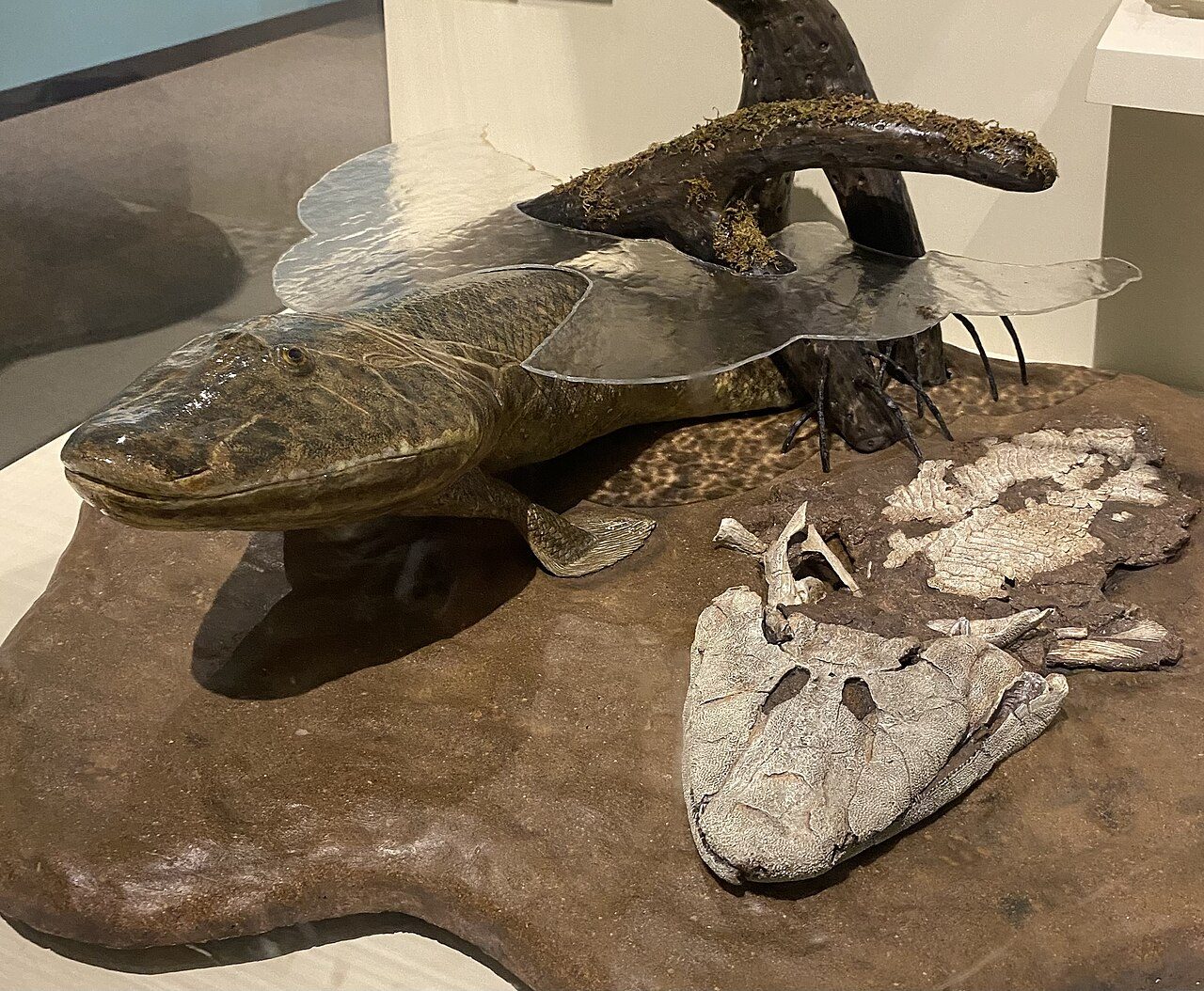
Animals followed the plants. About 375 million years ago, in shallow streams in what is now Arctic Canada, lived Tiktaalik. It had fins, scales and a primitive jaw like a fish, but also a neck, ribs and bones in its front fins like those in the limbs of land animals. It sits right at the step between fish and the first four-legged animals, the tetrapods. Every amphibian, reptile, bird and mammal, including you, descends from animals like it.
The egg that changed everything
The first tetrapods still had to go back to the water to lay their eggs, as frogs do today. In the Carboniferous came the amniote egg. It let the ancestors of reptiles, birds and mammals lay eggs on dry land without them drying out. From then on, animals could live their whole lives away from water.