Our sources give no reliable size for Anomalocaris, so this outline of its body shape is not drawn to scale.
- When
- Fossils about 514 million years old studied in 3D
- Where
- South Australia, and Cambrian rocks elsewhere
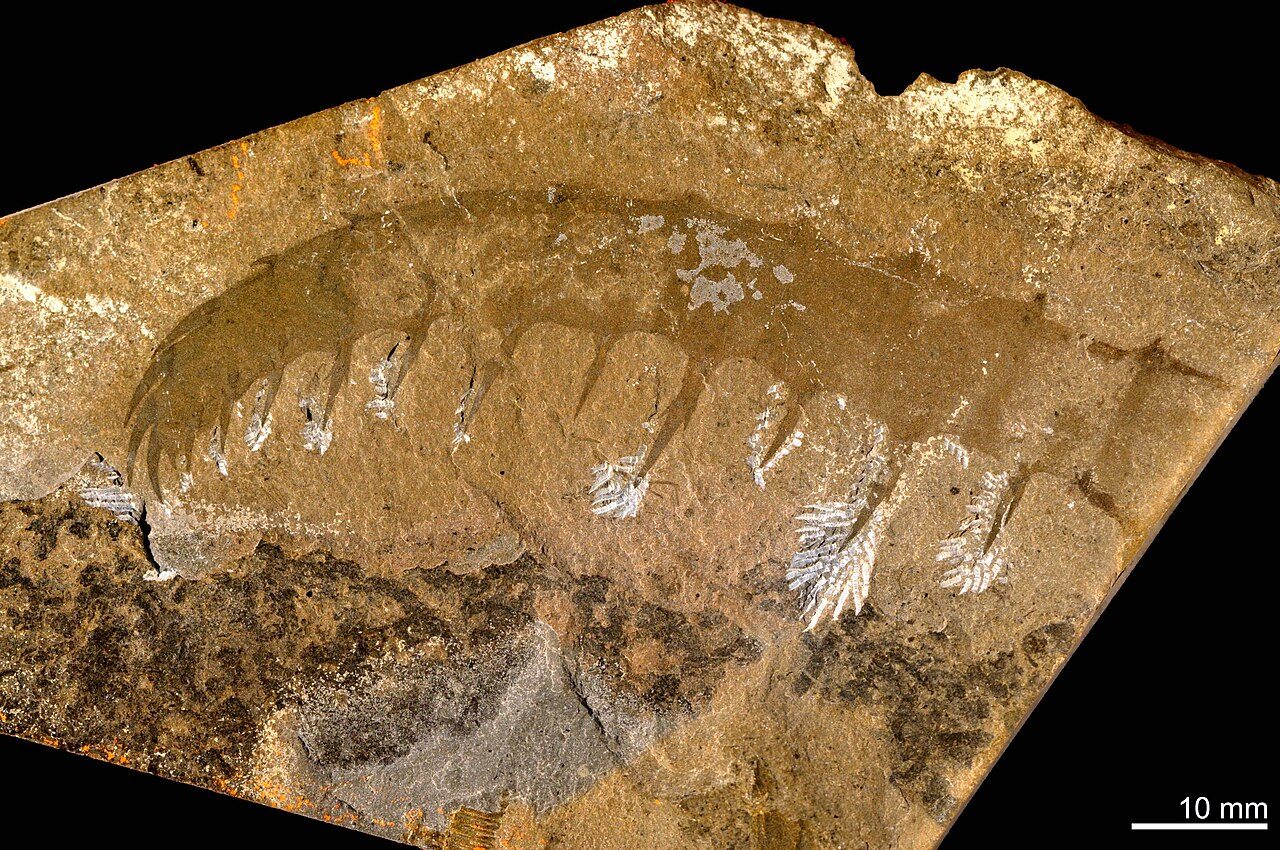
Anomalocaris was one of the formidable predators of the Cambrian, an early relative of the arthropods.
In 2011 scientists studied the surface of its eyes in 3D for the first time, using 514-million-year-old fossils from South Australia. Its compound eyes were made of many hexagonal lenses, the same shape as the lenses in the eye of a modern housefly.
Read more in The first animals.
Also in early animals
- Charnia A frond-shaped living thing from the Ediacaran sea floor
- Auroralumina attenboroughii Described by its finders as the earliest known animal predator
- Wiwaxia A small, spiny, scaly animal from the Burgess Shale
Sources
- Natural History Museum, London, Eyes on the prize: the evolution of vision