Ancient life · Early animals
Auroralumina attenboroughii
Described by its finders as the earliest known animal predator.
Our sources give no reliable size for Auroralumina attenboroughii, so this outline of its body shape is not drawn to scale.
- When
- About 560 million years ago
- Where
- Charnwood Forest, Leicestershire
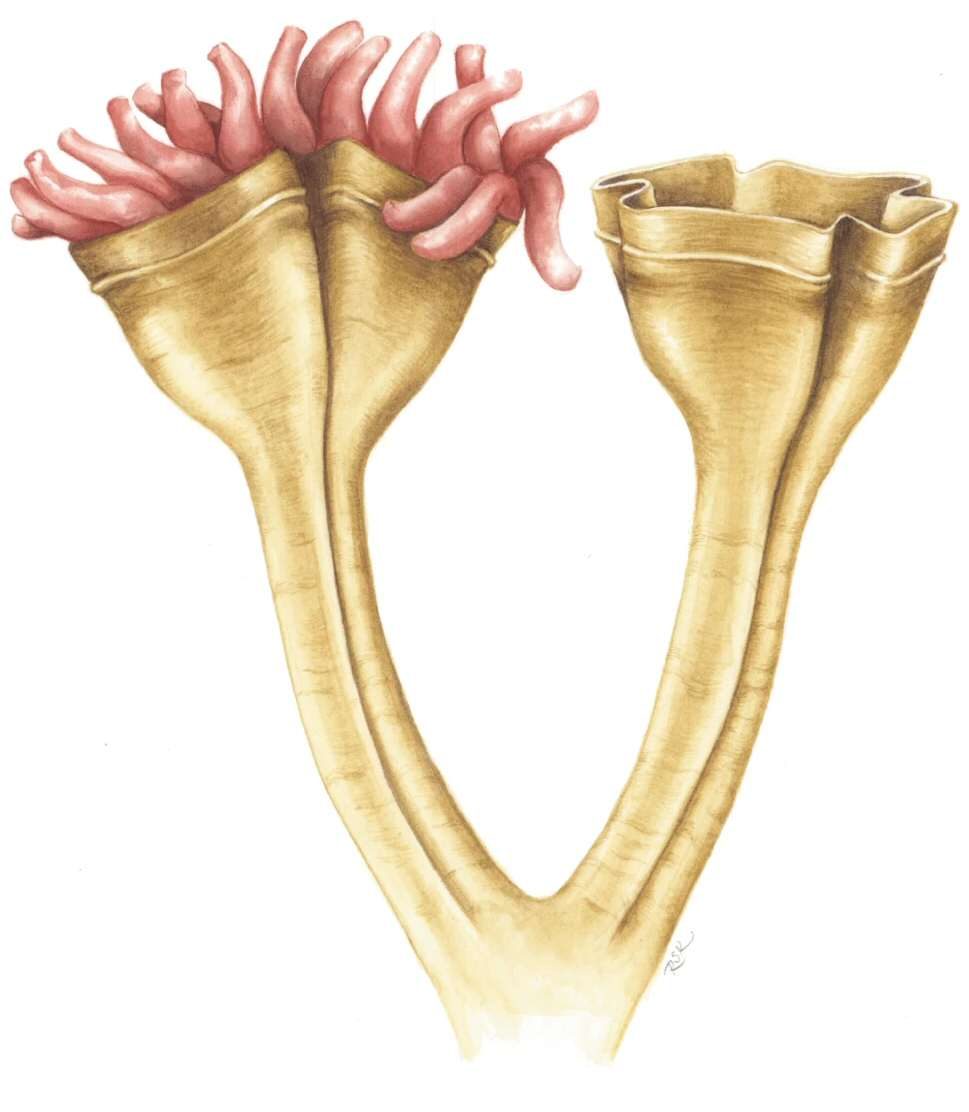
Found in Charnwood Forest and announced in 2022, this 560-million-year-old fossil was described by the team who studied it as the earliest known animal predator. It had a skeleton and densely packed tentacles that waved in the water to catch passing food, much as corals and sea anemones do today.
It is related to the group that includes corals, jellyfish and anemones. That group was thought to appear in the Cambrian explosion, about 540 million years ago, so this fossil is about 20 million years earlier than expected. It is named after Sir David Attenborough, who hunted fossils in the same area as a schoolboy in Leicester.
Found in Britain. See where Britain was at the time in Britain’s journey.
Read more in The first animals.
Also in early animals
- Charnia A frond-shaped living thing from the Ediacaran sea floor
- Anomalocaris A Cambrian predator with huge compound eyes
- Wiwaxia A small, spiny, scaly animal from the Burgess Shale
Sources
- British Geological Survey, 560-million-year-old fossil is first animal predator