Learn · Life · 7 minute read
Where life began
Everything alive shares one ancestor, and a study of genes says it lived 4,200 million years ago. Here is the evidence, and how sure we can be of each piece.
Every living thing on Earth, from bacteria to oak trees to you, is related. All cells build their proteins from the same set of amino acids, store their genes in DNA, use the same molecule, ATP, to carry energy, and make proteins with the same machinery, the ribosome. The simplest explanation is that all of life shares one ancestor.
Scientists call it LUCA, the last universal common ancestor. It sits at the root of the tree of life, before the split into the three great groups of living things: bacteria, archaea, and the eukaryotes, the group that includes plants, fungi and animals.
How sure can we be?
The early Earth left very few rocks, and most of those have been heated, crushed and folded since. So the evidence for early life is patchy, and each piece comes with a different kind of certainty. Here it is in order, oldest first.
- 4,540 MaMeasured
The Earth forms
Meteorites and the oldest rocks give the Earth’s age, accurate to about 1%.
- 4,404 MaMeasured
Liquid water
A zircon crystal from Jack Hills, Western Australia, carries chemical signs that it formed from rock that had been near liquid water.
- About 4,200 MaEstimated from genes
Our last common ancestor
Comparing the genes of living things suggests that LUCA, the ancestor of all life today, lived about 4,200 million years ago, somewhere between 4,090 and 4,330.
- 3,700 MaDisputed
Stromatolites in Greenland?
In 2016, scientists reported microbial mounds in rocks of this age in Greenland. In 2018, another team found they were more likely folds made in the rock long after it was buried.
- 3,430 MaFossil evidence
Microbial reefs
In the Pilbara of Western Australia, fossil reefs built by mats of microbes survive in rock 3,430 million years old.
LUCA
In 2024 a team led from the University of Bristol worked out when LUCA lived. They compared the genes of living species and counted the changes that have built up since they shared an ancestor. The fossil record fixes the dates of some later splits, and from those they could work back. Their answer was about 4,200 million years ago, only about 400 million years after the Earth itself formed. The scientists said they did not expect LUCA to be so old.
They also rebuilt what LUCA was probably like. It was not a simple blob. Its genome was probably at least 2.5 million letters long, coding for around 2,600 proteins, much like bacteria today. It seems even to have had an early immune system, which means it was already fighting off viruses.
LUCA was not necessarily the first life. It is simply the most recent ancestor shared by everything alive today.
The oldest fossils
In 2016, scientists described small cone-shaped and dome-shaped mounds in 3,700 million year old rocks in Greenland and argued they were stromatolites, built by microbes. If so, they would be the oldest fossils known. In 2018, a second team studied the same rocks in three dimensions, with their chemistry, and concluded that the mounds were more likely made by the rock being deformed long after it was buried, with nothing living involved. The question is still argued over.
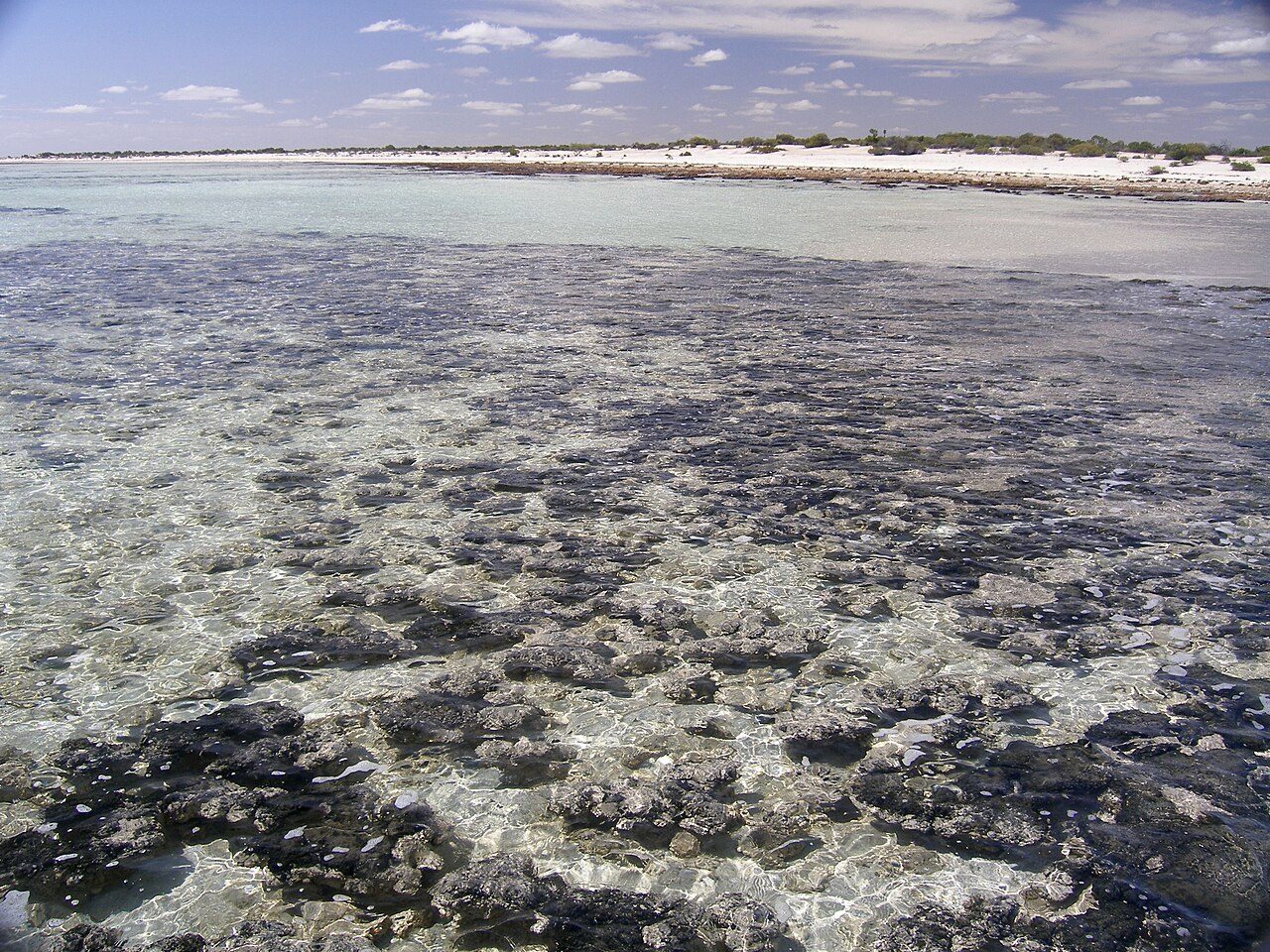
The Pilbara reefs of Western Australia, 3,430 million years old, are among the oldest fossil evidence of life. Microbes trapped sediment there in layers and built domes and cones, and similar mounds are still being built today in a few very salty bays.
How did it start?
This is one of the great open questions in science, and the rocks from the time have not survived to help answer it. What the evidence does say is that life began early, possibly within a few hundred million years of the Earth forming, and that for most of the Earth’s history it stayed microscopic. You can follow what came next in How the air changed and The first animals.