Learn · Life · 7 minute read
How dinosaurs became birds
Feathers came first, beaks came late, and the pigeon outside is a dinosaur. How a bird was put together over 100 million years.
Look out of the window and you may well see a dinosaur. Birds evolved from a group of two-legged, meat-eating dinosaurs called theropods, the same group as Tyrannosaurus rex and Velociraptor. They come from the small theropods, not the giant ones, and they are the only dinosaurs still alive.
Feathers came first
For a long time, people pictured dinosaurs as huge scaly lizards. That changed in 1996, when the first feathered dinosaur was announced. Many more have been found since. Most scientists now think that feathers, the most obvious mark of a bird, evolved in dinosaurs long before the first birds.
The first animals that scientists call bird-like are feathered dinosaurs that appeared about 165 to 150 million years ago. The change from fast-running, ground-dwelling theropods to small flying birds probably started about 160 million years ago, perhaps when some small theropods moved into the trees for food or safety. Over time, some theropod groups got smaller and smaller, and their skeletons changed in many other ways.
Archaeopteryx
When Archaeopteryx was unearthed in 1861, it was the oldest bird-like creature known to science. It is about 150 million years old, had feathers and wings, and is still often called the first bird. The first Archaeopteryx skeleton found is on show in the Treasures Gallery of the Natural History Museum in London.
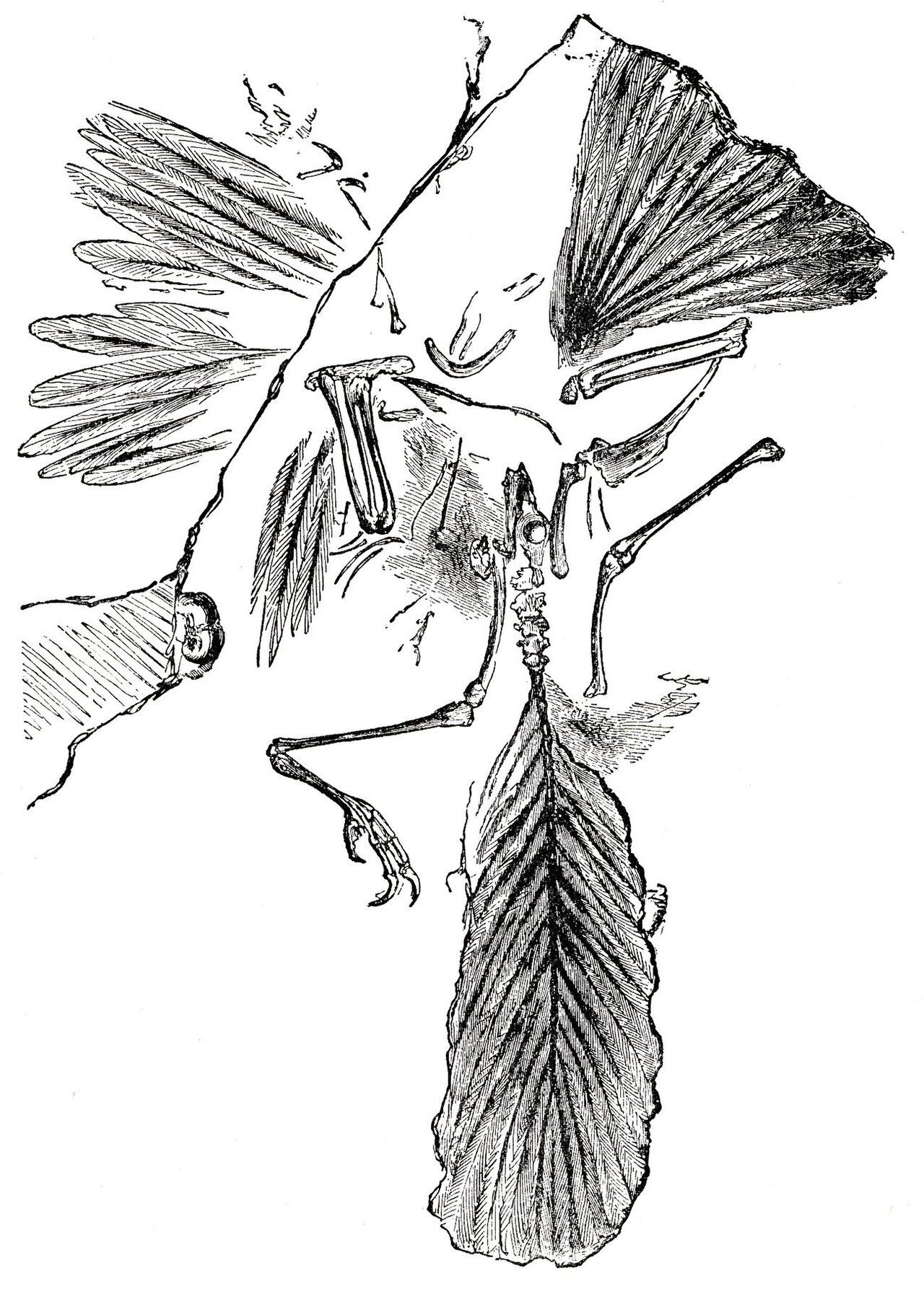
But many scientists say it was not quite a bird. It had a lot that birds have, and a lot that they do not. There is even debate about whether it could fly or only glide. As Professor Daniel Field puts it: “Although you can’t unambiguously call Archaeopteryx a bird, it is unambiguously a dinosaur.”
| Feature | Archaeopteryx | Living birds |
|---|---|---|
| Feathers | Yes | Yes |
| A pair of wings | Yes | Yes |
| A wishbone | Yes | Yes |
| Sharp, pointed teeth | Yes | No |
| A long, bony tail | Yes | No |
| Long claws on its hands | Yes | No |
What makes a bird?
Birds today are easy to tell apart from other animals. They have feathers and a pair of wings, and apart from bats they are the only living animals with backbones that can truly fly. Less obviously, they usually have a hollow skeleton, a large brain for the size of their head, and they are warm-blooded. Living birds have no teeth, though some water birds have tooth-like ridges on their beaks for gripping slippery prey.
These features turned up at different times. Birds seem to have lost their teeth and gained a fully toothless beak only about 120 million years ago, late in their story. A hollow skeleton may have come about 100 million years before that. That is why “what was the first bird?” has no simple answer: there was no single moment when a dinosaur became a bird.
The dinosaurs that survived
Sixty-six million years ago, after more than 140 million years in charge, the reign of the dinosaurs ended when a huge asteroid struck and massive volcanic eruptions changed the environment. Most dinosaurs died out. Only birds remained. Over the next 66 million years they evolved to live in many different habitats, and today there are at least 11,000 species.
Why did birds make it when the rest did not? The answer probably lies in a mix of things: they were small, they could eat many different foods, and they could fly. You can follow the rest of the dinosaur story in The dinosaurs and Mass extinctions.