Learn · Life · 8 minute read
Mass extinctions
Five times, most life on Earth has died in a geological instant. What the rocks say happened, and what is happening now.
Species come and go all the time. Most of the species that have ever lived are gone. Usually they disappear slowly, a few at a time, and new ones evolve to take their place. That steady turnover is called background extinction.
Five times in the last 540 million years, something very different happened. Over a short stretch of geological time, sometimes thousands of years and sometimes far less, about three quarters or more of all species disappeared. These are the Big Five mass extinctions. Each one ends a chapter in the rocks, and several mark the boundaries between the periods on the geological time scale.
The Great Dying
The worst of all came at the end of the Permian, 251.9 million years ago. In Siberia, eruptions poured out lava and gas on a scale never seen by people. The planet warmed, the oceans became more acidic and lost much of their oxygen. An estimated 96% of species were lost. Trilobites, which had lived in the seas since the Cambrian, were gone for good. Life took millions of years to recover. Among the survivors were the ancestors of the dinosaurs.
A clue in a thin layer of clay
In the 1970s the American geologist Walter Alvarez was studying limestone near Gubbio in Italy. Between the last Cretaceous layer and the first layer above it was a band of clay only a centimetre or two thick. With his father, the physicist Luis Alvarez, and the chemists Frank Asaro and Helen Michel, he measured the metal iridium in it. Iridium is rare in the Earth's crust but much more common in asteroids. The clay held far more than the rock above and below. In 1980 they proposed that a giant asteroid had hit the Earth and caused the extinction.
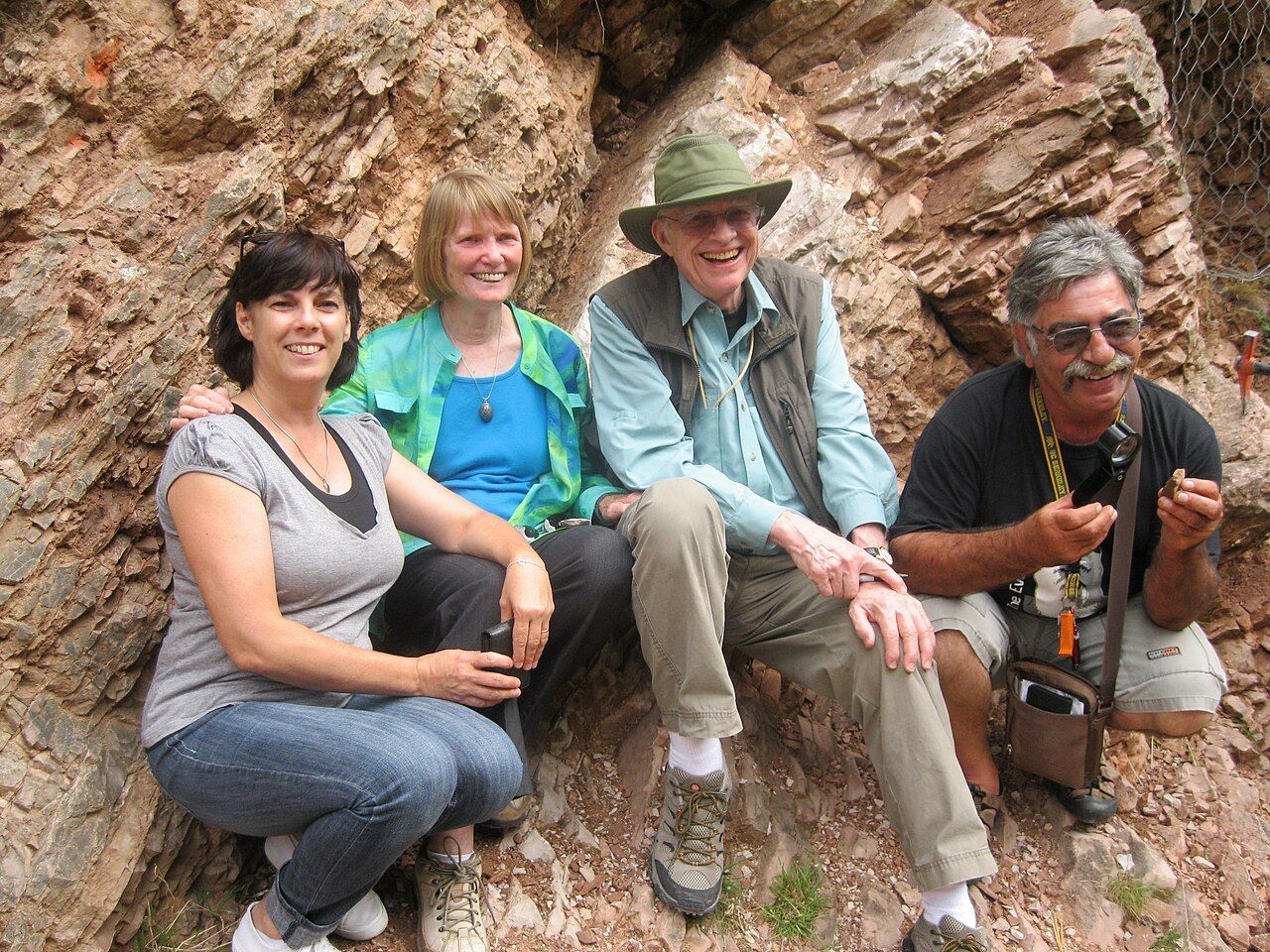
Many scientists doubted it at first. Then, in 1991, a buried crater was identified at Chicxulub, on the Yucatán peninsula of Mexico, of the right age and size. In 2010, a panel of 41 researchers reviewed the evidence and concluded that the impact caused the extinction. Non-bird dinosaurs, the giant sea reptiles and the last ammonites disappeared. The small mammals that survived went on to fill the world, and one line of them eventually led to us.
Is there a sixth?
In 2011 a team led by Anthony Barnosky compared today's losses of species with the Big Five. They found that the recent losses are serious, but not yet at the scale of a mass extinction. They also found that if the species now threatened were lost, the Earth could reach that level within just a few centuries. Unlike the asteroid, this is something people can change.