Up to 2.63 m long and 55 cm wide, estimated from the Northumberland fossil. Beside a person 1.75 m tall; ticks every metre.Body shape drawn for this site
- When
- Early Carboniferous to Early Permian
- Where
- Found in Britain at Howick Bay, Northumberland, and elsewhere
- Size
- Up to 2.63 m long and 55 cm wide, estimated from the Northumberland fossil
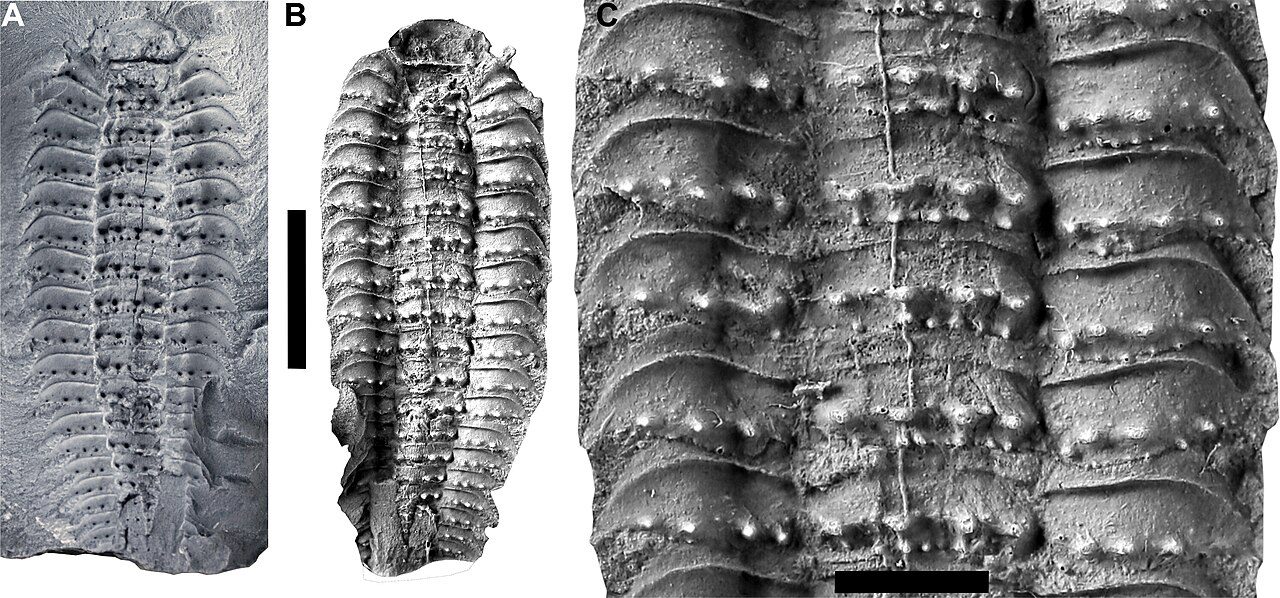
Arthropleura was a giant relative of millipedes that lived from the early Carboniferous to the Early Permian. A piece of one found on a beach in Northumberland, 76 by 36 cm, is part of a shed skin. The animal that left it is estimated to have been up to 2.63 metres long and 55 cm wide.
By that estimate it is the largest arthropod known from the whole of Earth’s history, a little longer than the biggest sea scorpions.
Found in Britain. See where Britain was at the time in Britain’s journey.
Read more in Coal forests.
Also in onto the land
- Cooksonia One of the first plants with pipes for water
- Tiktaalik roseae A fish on the way to becoming a four-legged animal
Sources
- N. S. Davies and others, Journal of the Geological Society 179, The largest arthropod in Earth history: newly discovered Arthropleura remains, Northumberland (2021)